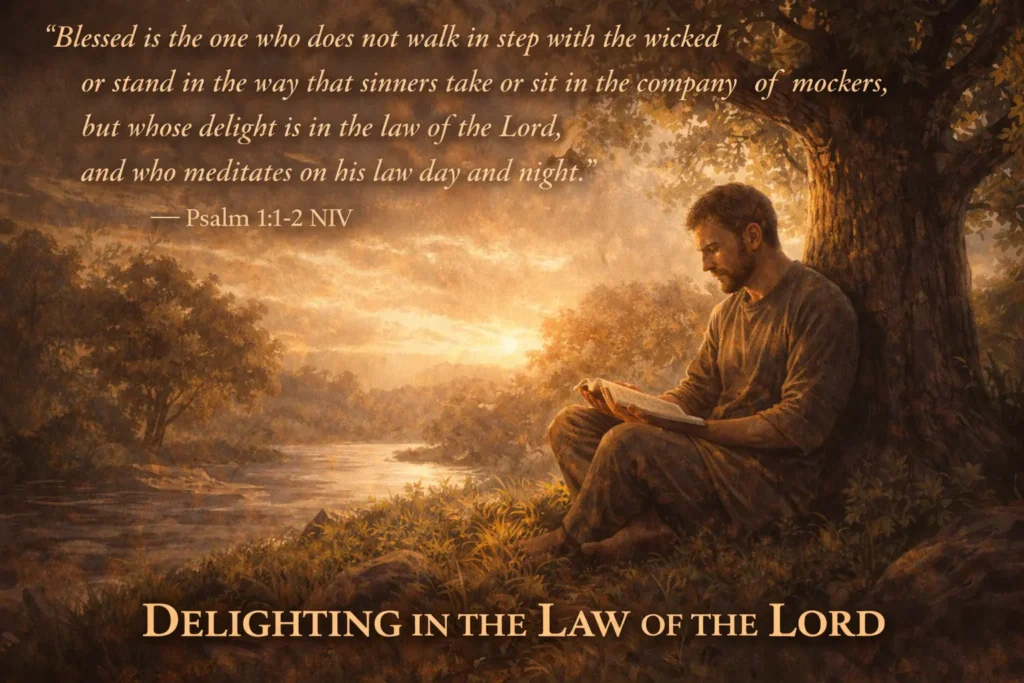
“Blessed is the one who does not walk in step with the wicked or stand in the way that sinners take or sit in the company of mockers, but whose delight is in the law of the Lord, and who meditates on his law day and night.” — Psalm 1:1–2 NIV
David wrote his best Psalms in the worst circumstances.
Not in the palace. Not in the years of military success and political stability. In the wilderness of En Gedi, hiding from Saul in a cave. On the run from his own son Absalom. In the ash-covered aftermath of Bathsheba and Nathan’s confrontation. The Psalms that have sustained two thousand years of Christian prayer were forged in conditions that would break most people.
That is the curriculum. And it is the exact curriculum that teenage boys need — not the sanitized version of faith that filters out the mess, but the raw, documented, specifically honest record of what it looks like when a man who loves God also fails spectacularly and comes back.
Psalm 1: The Foundation of Character
The Psalter opens with a character study. Psalm 1 describes two men — not by their achievements or their circumstances, but by what they orient their inner life toward and who they spend time with.
The blessed man — ashere in Hebrew, a word that carries overtones of happiness, flourishing, and being on the right path — does not take his cues from three specific influences: the counsel of the wicked, the path of sinners, or the company of mockers. The three nouns describe a progressive movement from influence to habituation to identity. First you listen to ungodly counsel. Then you walk in ungodly patterns. Then you sit down with those who mock what is true. Each step goes deeper.
The alternative is equally progressive. The blessed man delights in and meditates on God’s instruction — the Hebrew torah, which includes not just law but the entire revealed will of God. Meditates — hagah — carries the image of the low sound a person makes while reading aloud, the subvocalization that indicates deep engagement rather than surface scanning.
Character, Psalm 1 argues, is the product of sustained attention. What you attend to over time is what you become. The young man who habitually puts himself in the company of mockers and habitually withholds his attention from God’s word will produce a predictable outcome. And the young man who does the opposite will produce a different one. This is not moralism. It is developmental psychology with a three-thousand-year track record.
Psalm 23: Trust Under Threat
Every teenage boy will eventually walk through a valley where the shadow of death feels very close. It may be the illness of a parent. The dissolution of the family. A threat he faces in his peer environment that he cannot tell any adult about. A depression that has no obvious cause and no obvious solution.
Psalm 23 is the text for that valley. And the thing most people miss about it is the sequence. David wrote ‘even though I walk through the darkest valley’ — not around it, not over it. Through. The valley is not a mistake in the itinerary. The Good Shepherd does not reroute around the valleys. He walks with the sheep through them.
‘You are with me’ is the pivot of the Psalm. The rod and the staff — instruments of protection and guidance — are present. The table is prepared in the presence of enemies — not after the enemies are defeated, but while they are still present. The overflowing cup and the anointing oil are present in the same landscape as the darkness.
The character formation of Psalm 23 is this: you can be okay in the valley. You do not have to wait until you are out of it to be sustained. The Shepherd is in the valley, and the Shepherd is enough.
Psalm 51: Character After Catastrophic Failure
Psalm 51 is David after Bathsheba. After adultery and premeditated murder and a year of covered sin that the prophet Nathan finally named to his face. It is the most honest prayer of repentance in Scripture, and it is worth giving to every teenager who believes that a catastrophic moral failure ends the story.
David did not minimize what he had done. Verses 3–4 are specific: ‘For I know my transgressions, and my sin is always before me. Against you, you only, have I sinned and done what is evil in your sight.’ No deflection. No partial confession. Full acknowledgment of the full weight of the act.
Then, built on that foundation of honest acknowledgment, comes one of the most remarkable requests in the Psalter: ‘Create in me a pure heart, O God, and renew a steadfast spirit within me’ (51:10). The Hebrew bara — create — is the same word used in Genesis 1:1 for God’s act of bringing something into existence from nothing. David was not asking for renovation. He was asking for creation. A new heart where the old one had demonstrated its fundamental corruption.
The character lesson: failure is not the last chapter. But it is only survivable when it is fully faced. The man who minimizes, deflects, or manages the consequences of his failures rather than bringing them honestly to God will carry the weight of them indefinitely. David brought the full weight. And he walked out the other side of Psalm 51 with a heart that God called pure — not despite the failure, but through the honest confrontation with it.
Psalm 27: Courage in the Face of Real Fear
Psalm 27 is David facing enemies that are not hypothetical. ‘Though an army besiege me, my heart will not fear; though war break out against me, even then I will be confident’ (27:3).
That confidence was not bravado. David knew armies. He had run from them. He had led them. The confidence of Psalm 27 was built on a specific foundation stated in verse 1: ‘The Lord is my light and my salvation — whom shall I fear? The Lord is the stronghold of my life — of whom shall I be afraid?’
The courage is derived, not native. David was not describing a personality trait. He was describing a theological position: the God who is my light and my salvation and my stronghold is larger than the army outside the door. Therefore my fear is real and manageable simultaneously.
For a teenage boy, the armies are different. Social rejection. The fear of not being enough. The threat of physical violence in some environments. The terror of watching a parent’s health fail. Psalm 27 does not promise the armies will go away. It promises a stronghold — a position of security that exists regardless of whether the armies are still present.
The Curriculum of the Psalms
Give a teenage boy these four Psalms in this order and you have given him a character curriculum that covers the essential ground.
Psalm 1: what kind of person are you going to be, and what will you attend to? Psalm 23: what do you do in the valley? Psalm 51: what do you do after catastrophic failure? Psalm 27: how do you maintain courage when the threat is real?
That is not a children’s curriculum. It is a man’s curriculum — written by a man who was a shepherd, a fugitive, a soldier, a king, an adulterer, a murderer, a father who watched a son die in rebellion against him, and a worshipper who never stopped bringing it all back to God.
The Psalms are not the soft section of Scripture. They are the honest section. Give them to the boys who need honest things.
Reflection Questions
1. Which of the four Psalms covered here — 1, 23, 51, or 27 — is most relevant to where the young man in your life is right now?
2. How does Psalm 51 reframe the role of catastrophic failure in character formation? What would it mean to take a teenage boy through that Psalm after a genuine moral failure?
3. What is the difference between the courage of Psalm 27 and bravado? How do you teach a teenage boy the difference?
Paul R. Schmidt writes on faith, mentorship, and Christian survival fiction at myfaithtales.com. The character arc of Logan Murdock across the trilogy is structurally built on the Psalm 1 to Psalm 51 progression.