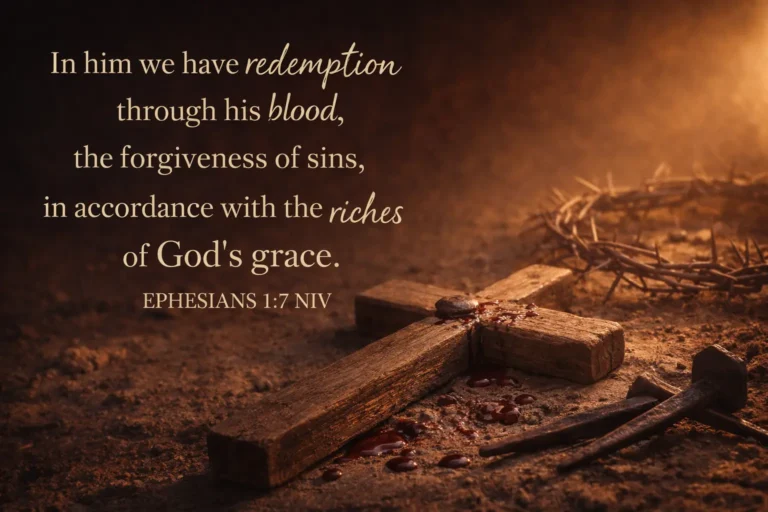
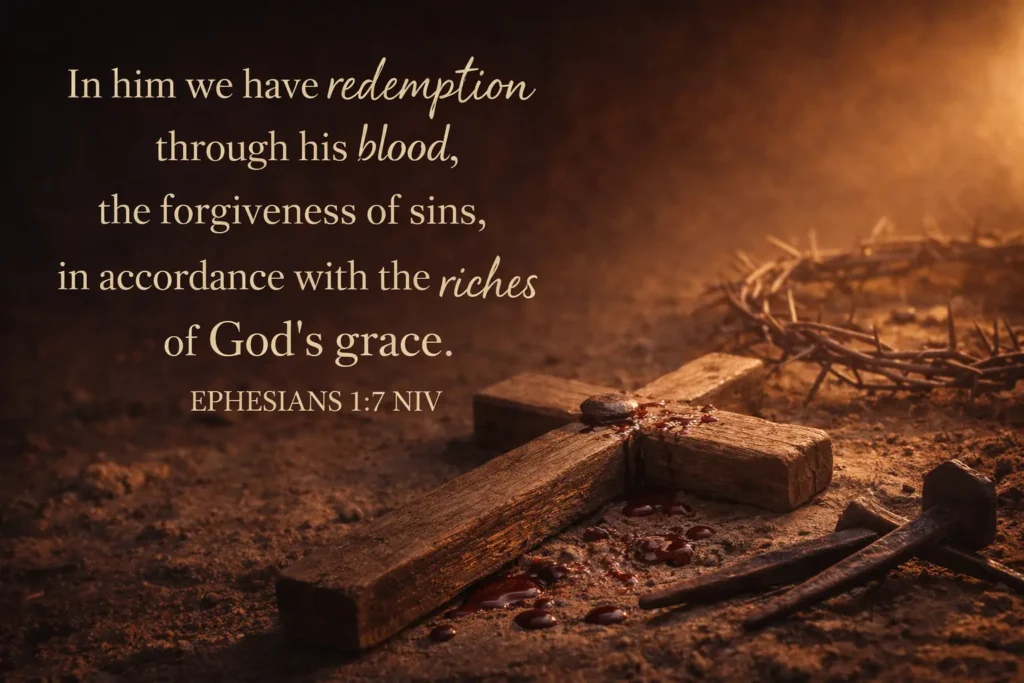
“In him we have redemption through his blood, the forgiveness of sins, in accordance with the riches of God’s grace.” — Ephesians 1:7 NIV
You cannot understand what Jesus did without understanding what you were before He did it.
The doctrine of redemption is not sentimental. It is transactional, legal, and brutally honest about the human condition. And it is the theological center of the entire Christian faith. Get redemption wrong — or vague — and everything else in Christian theology loses its weight.
The Hebrew Foundation: Go’el
The concept of redemption did not originate in the New Testament. Its roots run deep into the Old Testament through the Hebrew word ga’al and its active form, the go’el — the kinsman-redeemer.
In Israelite law, the go’el was a close relative who had the right and responsibility to redeem what had been lost. If a man sold himself into debt slavery, his go’el could buy him back. If a man died without an heir, his go’el married the widow to preserve the family line (the levirate marriage of Deuteronomy 25:5–6). If a man sold his land under financial pressure, his go’el could purchase it back and return it to the family.
The Book of Ruth turns entirely on this mechanism. Boaz acting as go’el for Naomi and Ruth is not just a romantic story. It is a theological paradigm embedded in Israelite law — and it is a deliberate prefigurement of Christ.
Redemption in the Hebrew framework required three things: the redeemer must be a relative (to have the right), the redeemer must have the resources (to have the ability), and the redeemer must be willing. All three conditions are met in Christ.
The Greek Language of Redemption
The New Testament draws on three related Greek word groups to describe what Christ accomplished: agorazō (to purchase in the marketplace), lutroō (to pay a ransom), and apolytrōsis (the noun form — redemption as the completed act of ransom).
The marketplace language is deliberate. Agorazō was used in the context of purchasing slaves in the agora — the public marketplace. When Paul wrote ‘you were bought at a price’ (1 Corinthians 6:20), his original readers understood the transaction metaphor precisely. They had seen slave markets. They knew what it looked like to pay for someone’s freedom.
The ransom language — lutron — appears directly in Jesus’ own words: ‘the Son of Man did not come to be served, but to serve, and to give his life as a ransom [lutron] for many’ (Matthew 20:28, Mark 10:45). A ransom is paid to release a captive. The question of who receives the ransom has been debated in atonement theology for centuries. But the structural point is clear: a price was paid, and the payment released what had been held captive.
What Were We Captive To?
Scripture identifies three primary forms of captivity from which humans need redemption.
First: the law. Galatians 3:13 states that ‘Christ redeemed us from the curse of the law by becoming a curse for us.’ The Mosaic law, though holy (Romans 7:12), revealed the standard that humanity consistently failed to meet. The accumulated debt of that failure was the ‘curse’ — the legal penalty for covenant violation.
Second: sin. Romans 6:6 describes the ‘body of sin’ — the pattern of willing rebellion against God’s character that marks fallen humanity. Redemption includes being ‘set free from sin’ (Romans 6:22) — not merely forgiven for it, but liberated from its dominating power.
Third: death. Hebrews 2:14–15 tells us that Jesus shared in human flesh and blood ‘so that by his death he might break the power of him who holds the power of death… and free those who all their lives were held in slavery by their fear of death.’ Physical mortality is included in the scope of redemption — pointing toward the bodily resurrection that Paul called the final ‘redemption of our bodies’ (Romans 8:23).
The Mechanism: Substitutionary Atonement
The dominant framework in Protestant theology for understanding how redemption was accomplished is penal substitutionary atonement — the doctrine that Christ bore the legal penalty for human sin in place of sinners, satisfying the justice of God while simultaneously expressing His mercy.
Isaiah 53 is the textual backbone: ‘He was pierced for our transgressions, he was crushed for our iniquities; the punishment that brought us peace was on him’ (53:5). Peter explicitly applies this to Christ (1 Peter 2:24). Paul does the same: ‘God made him who had no sin to be sin for us, so that in him we might become the righteousness of God’ (2 Corinthians 5:21).
The transaction: Christ took the penalty we owed; we received the righteousness He had earned. This is what theologians call the ‘great exchange.’ It is the mechanism by which redemption transfers from doctrine to personal reality.
Redemption Is Not Just Forgiveness
Forgiveness means the debt is cancelled. Redemption means the slave is free. These are not the same thing.
A prisoner whose sentence is commuted is forgiven. A prisoner who walks out of the cell into a new life has been redeemed. Christian redemption encompasses both — but the New Testament consistently emphasizes the transformative, liberating dimension. You are not just pardoned. You are purchased. You now belong to a different owner.
That ownership changes everything. Paul’s argument in 1 Corinthians 6:19–20 is: ‘Your bodies are temples of the Holy Spirit… You are not your own; you were bought at a price.’ The ethical implication of redemption is not just gratitude — it is belonging. The redeemed person is not free in the sense of owing nothing to anyone. They are free in the sense of being released from bondage to sin and death — and now oriented toward the one who paid the price.
The Transformative Power
This is where doctrine becomes biography. Redemption is not an abstract theological position. It is a claim about what happened to you personally.
You were in the pit. God saw it. He did not look away. He sent someone — or more precisely, He came Himself — to pay what you could not pay, bear what you could not bear, and walk out of the tomb so that you could walk out of yours.
Every person who takes the doctrine of redemption seriously eventually has to decide what to do with the price that was paid. You can acknowledge it intellectually. Or you can let it restructure your entire identity — moving you from ‘I manage my own life’ to ‘I belong to the one who bought me back.’
That second option is where transformation begins.
Reflection Questions
1. How does the go’el concept from the Old Testament deepen your understanding of what Christ did at Calvary?
2. What specific forms of captivity — to sin, to fear, to past identity — has Christ’s redemption addressed in your life?
3. What does it mean practically to live as ‘bought with a price’?
Paul R. Schmidt writes on faith, theology, and Christian survival fiction at myfaithtales.com.