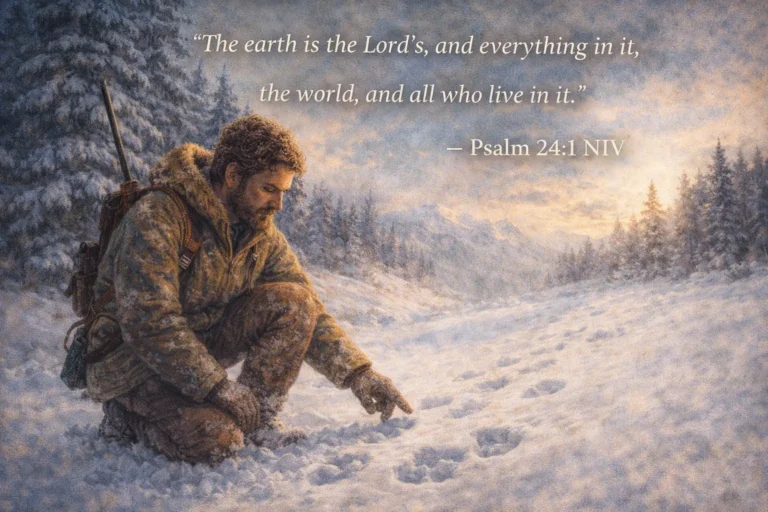
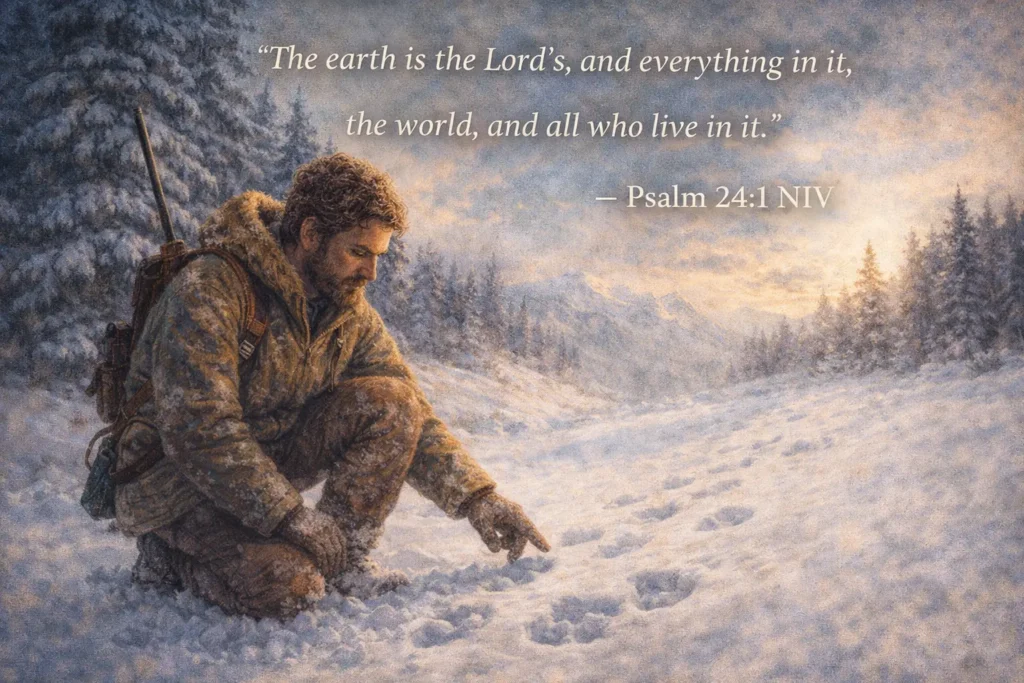
“The earth is the Lord’s, and everything in it, the world, and all who live in it.” — Psalm 24:1 NIV
He read the snow the way most people read a page.
Not slowly, with effort, decoding one symbol at a time. Fluidly — scanning, building a picture, moving through the narrative of what had passed through this terrain in the last twelve hours. The depth of each impression told him weight and speed. The spacing told him gait. The displacement pattern told him the animal’s level of alertness. The compressed edge of a track told him temperature and time. By the time he reached the end of the trail, he knew the animal the way a doctor knows a patient.
The Ojibwe people — Anishinaabe, the original people — developed tracking and wilderness skills over thousands of years in the Great Lakes region that remain among the most sophisticated in documented North American history. Understanding that tradition is not simply an exercise in anthropology. For a Christian writer building fiction in that terrain, it is an encounter with a people whose relationship with creation reflects something the Western tradition has largely lost and would do well to recover.
Who the Ojibwe Are: A Historical Overview
The Ojibwe (also spelled Ojibway or Chippewa) are one of the largest Indigenous nations in North America, with traditional territories spanning the Great Lakes region — from Ontario and Manitoba in the north to Minnesota, Wisconsin, and Michigan in the south. They are part of the broader Anishinaabe cultural and linguistic grouping, which includes the Potawatomi and Ottawa peoples.
Their oral history traces migration from the Atlantic coast to the Great Lakes region over several centuries, guided by what their tradition describes as spiritual instruction to follow the megis shell westward. By the time European contact became significant in the 17th century, the Ojibwe were an established woodland culture with sophisticated social structures, extensive trade networks, and a deep ecological knowledge of the boreal forest and Great Lakes environment that had been accumulated across hundreds of generations.
The fur trade era brought sustained contact with French and later British traders. The Ojibwe proved adaptable traders — entering economic relationships with Europeans while maintaining significant cultural continuity. Their canoe technology, which allowed rapid movement across the interconnected waterways of the Great Lakes watershed, made them essential partners in the continental fur economy.
The Tracking Tradition: Methodology and Knowledge
Ojibwe tracking knowledge was not a single skill but a complex of interrelated competencies developed over generations and transmitted through direct apprenticeship.
Reading Sign
Sign reading encompassed tracks, scat, feeding evidence, bedding areas, rub marks, hair catches, and the hundred other ways animals announce their presence and movement to a trained observer. Ojibwe trackers learned to distinguish species by track morphology, to estimate time of passage by track edge deterioration, to infer behavioral state from gait patterns, and to predict movement routes from terrain features and wind direction.
The knowledge was seasonal — the same terrain read differently in spring mud, summer dust, autumn leaves, and winter snow. A competent tracker carried not one reading of a landscape but four, updated by constant observation across years of practice.
Understanding Animal Behavior
Effective tracking required not just reading what an animal had done but predicting what it would do next. That required a depth of behavioral knowledge that only comes from sustained, attentive observation over multiple seasons. Ojibwe hunters knew the daily rhythms of the animals they pursued — feeding patterns, water sources, escape routes, bedding preferences, seasonal movements. They understood the relationship between weather and behavior, between terrain and movement, between prey and predator dynamics.
This was not romantic communion with nature. It was rigorous empirical observation accumulated across generations and encoded in oral tradition — a form of ecological science with a different transmission mechanism than the Western academic tradition but no less precise in its observations.
Canoe Navigation
The birchbark canoe was the Ojibwe’s most significant technological achievement — a craft so well designed for the specific conditions of the Great Lakes watershed that it remained unimproved in its essential design for centuries. Ojibwe canoe builders selected birch bark by thickness, grain, and flexibility. They waterproofed seams with spruce resin. They built frames from white cedar for lightness and strength. The resulting craft was light enough to portage over land between waterways and stable enough to handle open-water conditions on the Great Lakes.
Navigation across the interconnected river and lake systems of the northern forest required the same kind of multi-layered knowledge that tracking demanded — reading current, wind, weather, water depth, and seasonal change to move efficiently and safely through terrain that could turn lethal without warning.
The Spiritual Framework: Respect for Creation
Ojibwe traditional knowledge was embedded in a spiritual framework organized around the concept of respect for all living things — mitakuye oyasin in Lakota, a concept shared across many Plains and Woodland traditions. The Ojibwe equivalent is expressed through the concept of the manidoog — the spirits present in natural phenomena — and the obligation of reciprocity toward the living world.
A Christian engaging this framework needs to do so with both appreciation and discernment. The appreciation: the Ojibwe tradition’s insistence that the natural world deserves respect, that killing an animal is not a casual act but a significant one that carries moral weight, that the land is not simply a resource to be extracted but a place to be known and tended — these are positions that resonate deeply with the Christian doctrine of creation care rooted in Genesis 2:15’s command to ‘work and take care of’ the garden.
The discernment: the specific theological framework of animism and spirit-negotiation that underlies Ojibwe traditional religion is not compatible with Christian monotheism. The respect for creation that a Christian can affirm wholeheartedly does not require affirming the theological system in which that respect was embedded. The two things can be distinguished.
What Psalm 24:1 establishes — ‘the earth is the Lord’s, and everything in it’ — provides a theological basis for creation respect that is independent of animism: we tend the earth not because it contains indwelling spirits who require propitiation, but because it belongs to the God who made it and entrusted its care to us.
What the Ojibwe Tradition Teaches Christians About Attention
The most practically valuable thing the Ojibwe tracking tradition offers to a Christian formation is not a skill. It is a posture: the posture of sustained, humble, patient attention to the world as it actually is.
Modern Western culture — including most of evangelical Christianity — has cultivated an almost aggressive inattention to the physical world. We move through landscapes we cannot name, observe wildlife we cannot identify, eat food we cannot trace, and experience nature primarily through screens. The Ojibwe tradition represents the opposite extreme — a culture built on the assumption that the world is worth knowing deeply, and that knowing it well is a lifelong project requiring humility, patience, and the willingness to be wrong.
The God who made the tracking terrain, who built the behavioral patterns of every animal that moves through it, who designed the seasonal rhythms that a skilled tracker reads — that God is honored by the attention that makes skilled tracking possible. Psalm 19:1 says ‘the heavens declare the glory of God.’ But so does every track in the snow, if you know how to read it.
Reflection Questions
1. What aspects of the Ojibwe tracking tradition most clearly resonate with the Christian theology of creation care found in Genesis 2 and Psalm 24?
2. How does the posture of sustained, attentive observation of the natural world represent a spiritual discipline that most modern Christians have largely abandoned?
3. What is the difference between respecting creation because it contains indwelling spirits (animism) and respecting creation because it belongs to the God who made it (Christian stewardship)?
Paul R. Schmidt writes on faith, wilderness, and Christian survival fiction at myfaithtales.com. The Ojibwe tracking tradition is central to The Wilderness Watch, the second book in the Logan Murdock Trilogy.