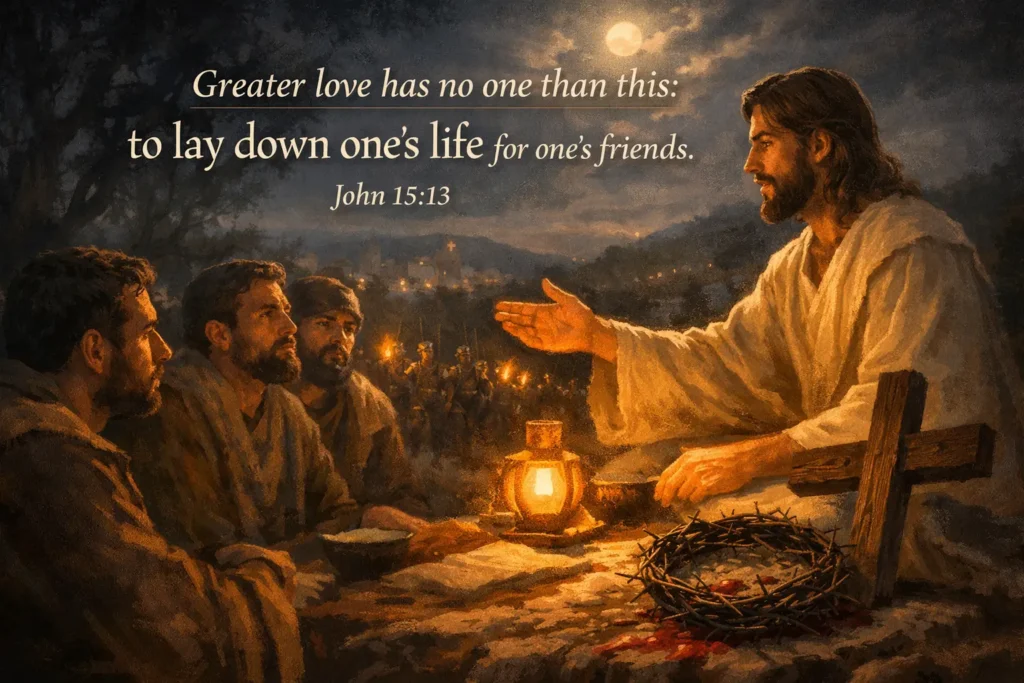
“Greater love has no one than this: to lay down one’s life for one’s friends.” — John 15:13 NIV
Thirteen words. That is all Jesus needed.
He said them the night before soldiers came for Him in the garden. The Passover meal was finished. Judas had already slipped out into the dark. The remaining eleven sat close, uncertain, their faces caught between loyalty and fear. And into that silence, Jesus spoke one of the most precise theological statements ever recorded.
This is not poetry. This is doctrine. John 15:13 is a load-bearing beam in Christian theology — and it deserves more than a cross-stitch on a wall.
The Immediate Context: John 15 and the Vine
Jesus had just finished the Vine and Branches discourse (John 15:1–12). He tells His disciples that they are branches connected to Him — the true vine. Apart from Him, they produce nothing. In Him, they bear fruit.
Then comes the command: ‘Love each other as I have loved you’ (John 15:12). And immediately — without pause — He defines what that love looks like at its highest possible expression.
Verse 13 is not a general observation about heroism. It is the specific standard by which disciples are called to love one another. It is both description and prescription.
The Greek Word: Agape and Its Weight
The word translated ‘love’ here is agapē — not philia (friendship affection) or eros (romantic desire). Agapē in New Testament Greek refers to a deliberate, willed, sacrificial love. It is chosen. It costs something.
John uses this same word throughout his Gospel and his epistles. It is the love God demonstrated in sending His Son (John 3:16). It is the love that defines Christian community (1 John 4:7–8). And here, Jesus frames it in terms of death.
The phrase ‘lay down one’s life’ — from the Greek tithēmi tēn psychēn — appears five times in the Gospel of John, and every instance points directly to Jesus. He is not speaking hypothetically about soldiers or martyrs. He is describing what He is about to do. In less than 24 hours.
‘For His Friends’: Who Is Included?
Here is where many readers pause. Jesus says He lays down His life ‘for his friends.’ Does that exclude enemies? Does that create a smaller circle than the ‘world’ of John 3:16?
Not quite. Look at what follows in John 15:14–15. Jesus redefines the term. His disciples are His friends — not because of their virtue, but because He has chosen them and revealed the Father to them. The friendship is initiated by Christ, not earned by the disciple.
And in Romans 5:10, Paul makes the theological arc clear: ‘While we were enemies, we were reconciled to God through the death of his Son.’ The sacrifice at Calvary was made for enemies who would become friends. The category of ‘friend’ was not a qualification Jesus imposed on the cross — it was a destination He was purchasing.
What This Verse Demands
Theologians call John 15:13 a proof-text for substitutionary atonement — the doctrine that Christ died in place of sinners, bearing the penalty they deserved. That is theologically accurate and profoundly important.
But there is a personal demand here too. Jesus has just told His disciples: ‘Love each other as I have loved you.’ The standard of love He sets is His own death. He does not set the bar low and then clear it at altitude. He sets it at ultimate cost — and then asks us to follow.
That does not mean every Christian is called to a martyr’s death. But it does mean every Christian is called to a love that costs something. A love that gives when it is inconvenient. That forgives when it is painful. That stays when it would be easier to walk away.
The Fulfillment: Calvary
Jesus spoke John 15:13 on Thursday night. By Friday afternoon, He had done it. The Roman soldiers drove nails through His wrists. The weight of sin — every last ounce of it — pressed down on Him as He hung between earth and sky.
He did not come down from the cross. He had the power to. The same hands that stilled storms and raised the dead stayed fixed to the wood. Because He loved His friends. Because He loved you.
John 15:13 is the definition of love. And Calvary is the proof.
Reflection Questions
1. How does Jesus redefine ‘friendship’ in John 15:14–15? What does it mean that He called His disciples friends?
2. Where in your life is God calling you to a love that costs something?
3. If agapē love is willed and chosen — not just felt — how does that change how you pursue love toward difficult people?
Paul R. Schmidt writes on faith, theology, and Christian survival fiction at myfaithtales.com. He is the author of The Logan Murdock Trilogy.