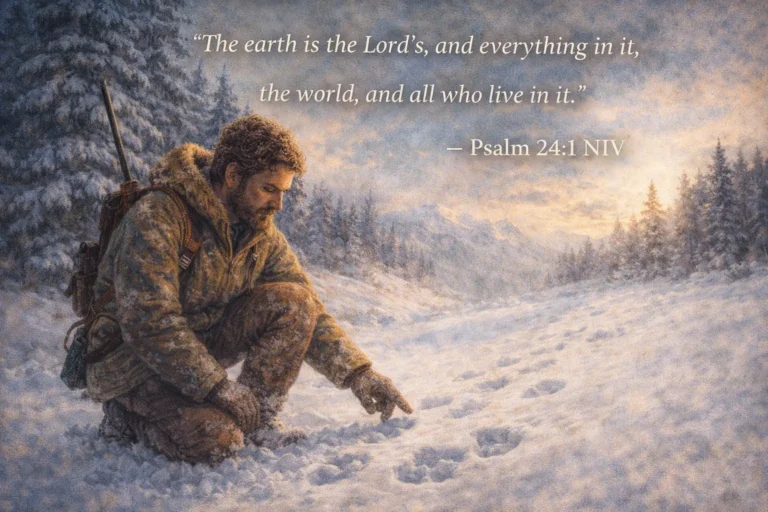
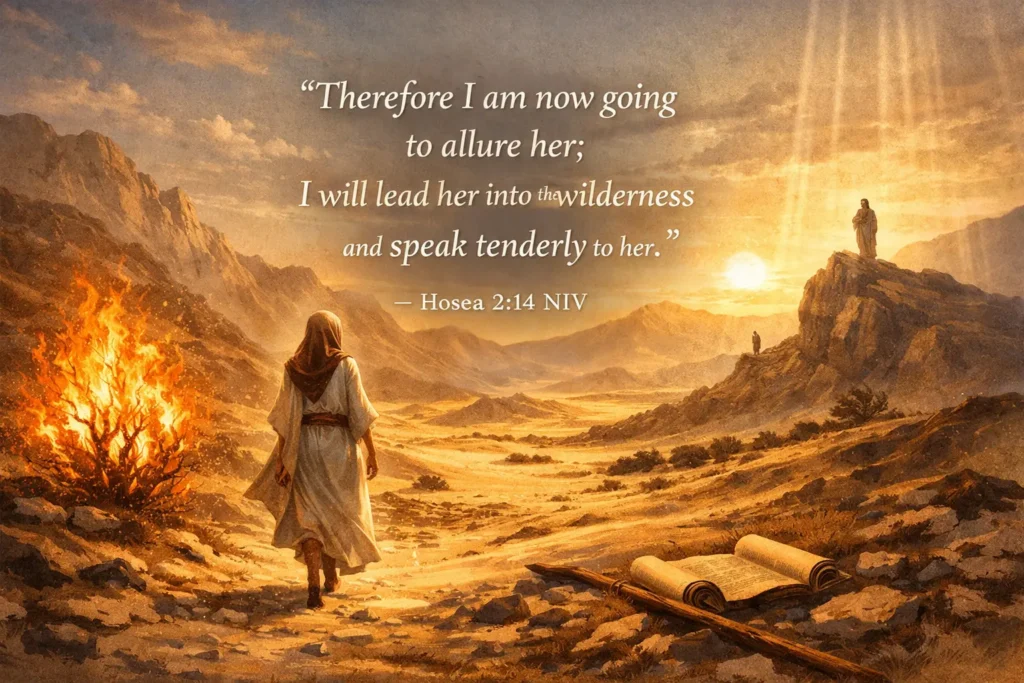
“Therefore I am now going to allure her; I will lead her into the wilderness and speak tenderly to her.” — Hosea 2:14 NIV
God keeps taking His people into the desert.
Not away from the desert. Not around it. Into it. The pattern runs from Genesis to Revelation and it is too consistent to be accidental. Every major figure in the biblical narrative spends significant time in the wilderness before their most important work begins. Every pivotal theological moment seems to require the removal of comfort, familiarity, and the noise of ordinary life.
The wilderness in Scripture is not punishment. It is preparation. It is not abandonment. It is a specific kind of appointment — the kind that requires the absence of everything false before the presence of everything real can be felt.
Understanding the wilderness motif does not just illuminate ancient Israel’s journey. It illuminates yours.
The Hebrew Word: Midbar
The Hebrew word most often translated ‘wilderness’ or ‘desert’ is midbar — from the root davar, which means to speak. The midbar is, etymologically, the place of speaking. The place where words are heard that cannot be heard in the noise of civilization.
That etymology is not incidental. The wilderness in the Hebrew imagination was not simply an ecological category. It was a theological one — the place where God’s voice, usually drowned out by the competing claims of city life, commerce, political maneuvering, and social obligation, could finally be heard with clarity.
Hosea 2:14 makes this explicit: ‘I will lead her into the wilderness and speak tenderly to her.’ God’s tender speech required the wilderness setting. The noise had to stop before the voice could be heard.
The Exodus: Forty Years as Theological Curriculum
Israel’s forty years between Egypt and Canaan is the foundational wilderness experience of the Old Testament — the event that all subsequent wilderness references echo and interpret.
Deuteronomy 8:2–3 provides the theological summary: God led Israel through the wilderness ‘to humble you and to test you in order to know what was in your heart, whether or not you would keep his commands. He humbled you, causing you to hunger and then feeding you with manna… to teach you that man does not live on bread alone but on every word that comes from the mouth of God.’
Three theological purposes embedded in the wilderness: humbling, testing, and teaching. God was not torturing His people with forty years of desert wandering. He was running a curriculum that could not be run in Egypt, where the granaries were full and the fleshpots were abundant and the temptation to trust in visible, tangible provision was irresistible.
You cannot learn that God is sufficient when you have substitutes for God readily available. The wilderness removes the substitutes. That is the entire point of it.
Moses: The Burning Bush Moment
Moses spent forty years in the wilderness of Midian before God spoke to him from the burning bush (Exodus 3). He had fled Egypt as a man of power and position — educated in Pharaoh’s household, trained for leadership, almost certainly expecting a different trajectory for his life. The desert took all of that. Forty years of tending sheep.
And then God spoke. From a bush that burned without being consumed — a physical image of the divine presence that illuminates without destroying. God identified Himself, named Moses’ specific calling, and launched the redemption of Israel.
The forty years were not wasted. They were the formation. The man who stood before Pharaoh with a staff in his hand was not the man who had fled Egypt with a sword. The desert had stripped the Egyptian prince away and left something more durable: a shepherd who had learned that he was not the most important person in any room.
Elijah: The Wilderness of Collapse
1 Kings 19 is the wilderness as recovery room. Elijah arrived in the desert not as a man being prepared for his calling but as a man whose calling had temporarily broken him. He had run a day’s journey in and asked God to let him die.
The wilderness in this case was not preparation. It was the place where God met a man at the absolute end of his capacity and did not rebuke him. Fed him instead. Let him sleep. Fed him again. And then led him forty days deeper into the desert to Mount Horeb — the same mountain where Moses had heard God speak from the fire.
God did not appear to Elijah in the wind that tore the mountains apart. Not in the earthquake. Not in the fire. In the still small voice — the gentle whisper — that came after all of those. The wilderness had quieted Elijah enough that he could finally hear the quietest frequency of God’s communication.
John the Baptist: The Wilderness as Pulpit
Luke 1:80 says John the Baptist ‘lived in the wilderness until he appeared publicly to Israel.’ His entire formation happened in the desert. When he emerged at the Jordan, he was not the product of Temple education or rabbinic school. He was the product of the midbar — the speaking place.
Matthew 3:3 identifies him as ‘a voice of one calling in the wilderness, Prepare the way for the Lord.’ The wilderness was not just where John was formed. It was where Israel needed to come to hear the message. The prophet called the people out of their cities and institutions and into the desert to receive the word of preparation. The wilderness was the appointed location for the most significant prophetic ministry since Elijah.
Jesus: Forty Days Before the Ministry
Matthew 4:1 contains one of the most loaded sentences in the New Testament: ‘Then Jesus was led by the Spirit into the wilderness to be tempted by the devil.’
Led by the Spirit. This was not an ambush. It was an appointment. The Spirit who had just descended on Jesus at the Jordan — the same Spirit who hovered over the waters at creation — led Him directly into the desert. The temptation was not an interruption of the mission. It was part of it.
Forty days without food. Three specific temptations, each aimed at the precise character of His identity as the Son of God — provision, spectacle, and power. He answered each one with Scripture, each quotation drawn from Deuteronomy — the book that recorded Israel’s forty years of wilderness failure. Jesus was re-running Israel’s wilderness test and passing it perfectly.
When He came out of the wilderness, the ministry began. The healing. The teaching. The twelve. Calvary. The resurrection. All of it was preceded by the desert. The wilderness was not the prologue to the mission. It was the foundation it was built on.
The Wilderness Motif in Your Own Story
The seasons of your life that felt most like the wilderness — the medical waiting rooms, the financial collapses, the relational devastation, the long midnights of spiritual dryness — were not God’s absence. They were the midbar. The speaking place. The location where the substitutes for God were stripped away and the voice that could not be heard in the noise became, for the first time, audible.
That does not make the wilderness pleasant. Moses spent forty years there. Elijah barely survived his. Jesus spent forty days in it fasting and being systematically attacked. The wilderness is genuinely hard.
But the pattern is too consistent to dismiss. The people God used most significantly went through the wilderness first. The formation that happened there could not have happened anywhere else. And the God who led them into it did not abandon them in it. He spoke in it. He fed them in it. He appeared in fire and cloud and whispers and burning bushes in it.
He is in yours too.
Reflection Questions
1. Which wilderness figure — Moses, Elijah, John the Baptist, or Jesus — most closely mirrors the wilderness experience you are currently in or have recently come through?
2. What has the wilderness stripped away from you that turned out to be a substitute for God rather than a genuine good?
3. What has God spoken to you in the wilderness — the things that could not have been heard in the noise of normal life?
Paul R. Schmidt writes on faith, wilderness, and Christian survival fiction at myfaithtales.com. The wilderness terrain in the Logan Murdock Trilogy is both geographical and theological.