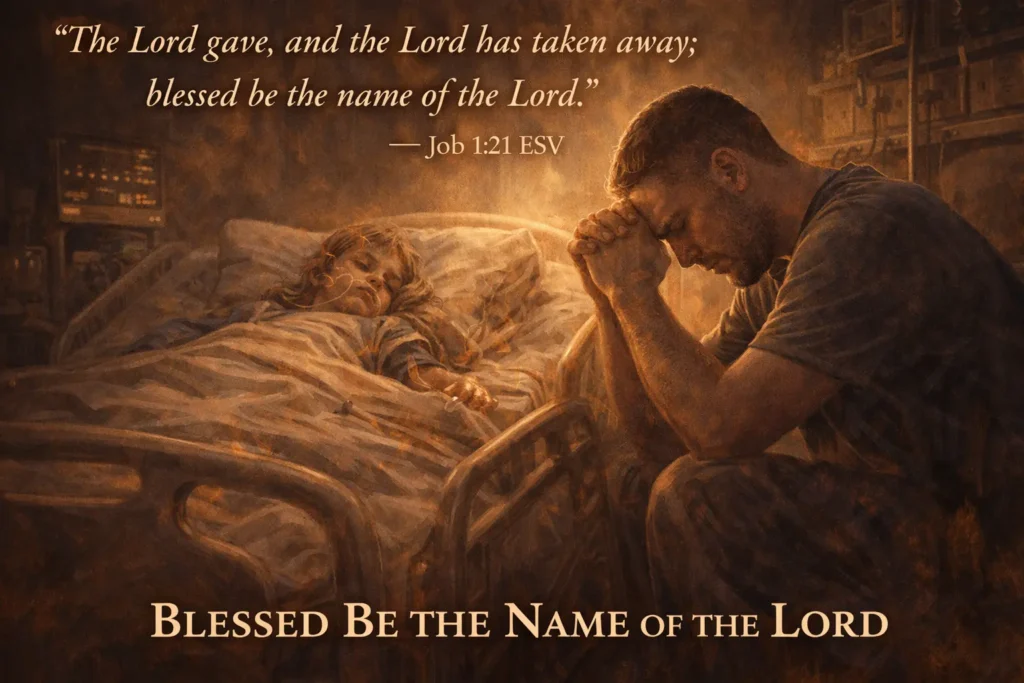
“The Lord gave, and the Lord has taken away; blessed be the name of the Lord.” — Job 1:21 ESV
The test results came back and nothing made sense.
That is where theodicy stops being an academic discipline and becomes a question you scream at the ceiling at 2 a.m. Your child is in a hospital bed. The doctors are doing their best. And somewhere in the gap between what medicine can explain and what faith demands, you are trying to hold two things simultaneously: God is good. This is happening.
That tension has a name. Theodicy — from the Greek theos (God) and dikē (justice) — is the attempt to reconcile divine goodness and power with the existence of suffering. The word was coined by the philosopher Leibniz in 1710, but the problem is as old as Job.
The Problem Stated Honestly
Epicurus framed the logical challenge in its sharpest form centuries before Christ: if God is willing to prevent evil but cannot, He is not omnipotent. If He is able but unwilling, He is not good. If He is both willing and able, why does evil exist?
Most Christian responses to this argument spend too much time on the logic and not enough time with the person asking the question. The person sitting beside the ICU bed does not need a syllogism. They need a framework that is honest about the pain and honest about the God who is present inside it.
Christian theodicy does not begin by defending God’s reputation. It begins with Job.
The Book of Job: What God Did Not Say
Job lost everything in a single day — livestock, servants, ten children, and eventually his health. His three friends arrived with explanations. Eliphaz argued that Job must have sinned (Job 4:7–8). Bildad insisted God rewards the righteous, so Job’s suffering proved his guilt (8:20). Zophar simply told him to repent and things would improve (11:13–19).
Every one of them had a coherent theological framework. And God told all three of them at the end of the book: ‘You have not spoken the truth about me, as my servant Job has’ (Job 42:7).
Job had screamed at God. Accused Him. Demanded an answer. And God called that more truthful than the neat theological package his friends offered.
That is a significant data point. God is not honored by explanations that protect His image at the cost of the sufferer’s dignity. He is honored by honest wrestling.
God’s Answer to Job: The Whirlwind
When God finally spoke in Job 38, He did not explain why Job suffered. He asked Job questions. Seventy-seven of them across four chapters — all pointed at the incomprehensible scale of creation and divine governance.
‘Where were you when I laid the earth’s foundation?’ (38:4). ‘Have you entered the storehouses of the snow?’ (38:22). ‘Can you bind the chains of the Pleiades?’ (38:31).
God’s response to theodicy was not an explanation. It was a revelation of His own nature — vast, attentive to detail, governing systems Job could not conceive. The implication is not ‘shut up and trust me.’ It is more specific: the God who designed the migration patterns of the mountain goat (39:1) and set the boundaries of the sea (38:8–11) is the same God present in the hospital room.
He is not absent from the suffering. He is governing it. And His governance operates at a scale of complexity that human vision cannot fully track from inside the crisis.
Romans 8:28: The Most Misused Verse in Suffering
‘And we know that in all things God works for the good of those who love him, who have been called according to his purpose.’
This verse is quoted at funerals and medical waiting rooms more than almost any other passage. And it is almost always misquoted.
Paul did not say all things are good. He said God works through all things toward good — specifically the good of conforming believers to the image of Christ (Romans 8:29). The good in view is not comfort or resolution. It is character formation and eternal conformity to the Son.
That is a harder promise than ‘it will work out fine.’ It means God is using the medical trial, the long nights, the fear, the exhaustion — using all of it — to produce something in you and in the people you love that could not be produced any other way.
That is not easy to sit with. But it is honest. And it is hope that does not require circumstances to change before it can function.
Sovereignty Does Not Mean Cruelty
One of the most persistent misreadings of divine sovereignty in suffering is the idea that God authored the suffering as punishment. Scripture pushes back on this hard.
John 9:1–3: the disciples saw a man born blind and asked Jesus whose sin caused it. Jesus answered that it was not the man’s sin or his parents’ — ‘but this happened so that the works of God might be displayed in him.’ The suffering was not punitive. It was purposive.
Jesus wept at Lazarus’s tomb (John 11:35) — even knowing He was about to raise him. He was not indifferent to the pain. He was present in it, moved by it, while simultaneously governing it toward a display of resurrection power that would strengthen faith in people who were about to watch Him walk into His own death.
God’s sovereignty over suffering is not the cold management of a divine administrator. It is the active, weeping, purposeful engagement of a Father who sees every detail and has not abandoned the plan.
For the Person in the Waiting Room
You do not need a complete theodicy right now. You need to know three things.
God sees exactly where you are. He is not confused by your child’s diagnosis. He is not surprised by what the scan revealed. He is present in the room, and His purposes are not derailed by what medicine cannot fix.
Honest grief is not a lack of faith. Job was called God’s servant in the middle of his worst arguments (Job 1:8, 42:7). The Psalms are full of men who accused God of sleeping (Psalm 44:23). Lament is a biblical category. Use it.
The story is not over at the worst chapter. Joseph’s brothers sold him into slavery. That was not the final page. Suffering that does not make sense in chapter 12 can make complete sense in chapter 50. You are inside the narrative, not above it. God is above it.
Reflection Questions
1. What specific explanation for your suffering have you been given that has felt more like Job’s friends than like God?
2. How does God’s response to Job from the whirlwind change what you expect when you bring your hardest questions to Him?
3. What does Romans 8:28–29 say the ‘good’ is that God is working toward — and how does that reframe your current situation?
Paul R. Schmidt writes on faith, theodicy, and Christian survival fiction at myfaithtales.com. His son’s fight with liver cirrhosis is the personal backdrop to much of his writing on suffering.