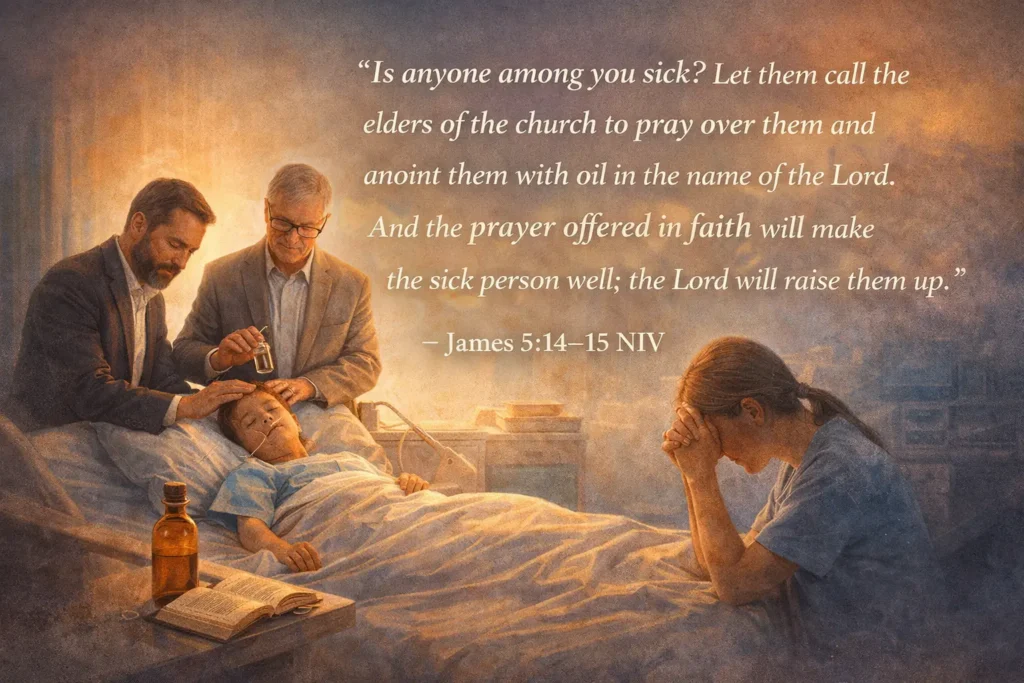
“Is anyone among you sick? Let them call the elders of the church to pray over them and anoint them with oil in the name of the Lord. And the prayer offered in faith will make the sick person well; the Lord will raise them up.” — James 5:14–15 NIV
You have prayed the same prayer for months. Maybe years.
You have prayed it in the hospital chapel at midnight. In the car on the way to another appointment. In the dark, in the quiet, in the specific way you pray when you are out of words and all that comes out is the name — just the name.
And the transplant list keeps moving. And the numbers keep shifting. And you keep praying.
The theology of healing prayer is not a comfortable topic. Not because God does not heal — He does, and the New Testament is full of evidence. But because He does not always heal in the way or the timing the person praying is asking for. And any theology of healing that cannot account for that reality is not a theology at all. It is wishful thinking with Bible verses attached.
What Scripture Actually Promises About Healing
James 5:14–15 is the most direct New Testament instruction on healing prayer. James told the sick person to call the elders, be anointed with oil, and be prayed over in the name of the Lord. He said ‘the prayer offered in faith will make the sick person well.’
That sounds absolute. And it has been used by well-meaning Christians to tell sick people that they are not healed because their faith is insufficient. That is a theological and pastoral catastrophe. It adds the weight of guilt to the weight of illness.
The full context of the passage — and the larger context of New Testament theology — does not support that reading. James 5:15 continues: ‘If they have sinned, they will be forgiven.’ The conditional structure suggests James understood that not all illness is simply a faith problem with a straightforward solution. Paul himself had a ‘thorn in the flesh’ that God did not remove despite three direct requests (2 Corinthians 12:7–9). Paul was not lacking in faith.
The Two Kinds of Healing Prayers
Theologians working in this space often distinguish between two categories of healing prayer, both of which are biblical.
The first is bold, expectant petition — the prayer that comes from a settled conviction that God can and intends to heal in this specific situation. Jesus modeled this in the Gospels. He did not pray tentative prayers over the sick. He commanded. ‘Stretch out your hand’ (Matthew 12:13). ‘Get up, take your mat and walk’ (John 5:8). The New Testament healing accounts have an authority and directness that is worth taking seriously.
The second is submitted, trusting petition — the prayer that brings the specific request to God while entrusting the outcome to His will and character. Jesus modeled this too. In Gethsemane: ‘Father, if you are willing, take this cup from me; yet not my will, but yours be done’ (Luke 22:42). The most theologically significant prayer in history was a healing prayer that ended in submission.
The mistake is treating these two categories as contradictory. They are not. Boldness and submission are not opposites. You can pray with full expectation that God heals — because He does — and simultaneously hold the outcome with open hands. The tension is not hypocrisy. It is mature faith.
Praying Without Certainty: What That Actually Looks Like
When your child is on a transplant waitlist, you do not have the luxury of abstract theology. You need something you can actually do at 3 a.m. Here is what Scripture gives you.
Pray specifically. Jesus consistently asked the person seeking healing: ‘What do you want me to do for you?’ (Mark 10:51, Luke 18:41). God is not honored by vague prayers. Name the organ. Name the number. Name the specific outcome you are asking for. He already knows. But the act of naming it is an act of faith — it is treating God as a Father who hears, not as a cosmic force that may or may not notice.
Pray persistently. The parable of the persistent widow (Luke 18:1–8) was told specifically ‘to show them that they should always pray and not give up.’ The implication is that persistent prayer is not a sign of insufficient faith. It is a sign of sustained faith.
Pray communally. James 5:14 is plural. The elders of the church. The community. There is a reason healing prayer in the New Testament is almost always corporate. Your prayers alone carry weight. They carry more in the company of others who share the faith and the burden.
Pray honestly. Tell God exactly how frightened you are. Tell Him what the numbers mean. Tell Him what you are asking for and why. He is not impressed by stoic composure in prayer. He is moved by honest, persistent faith.
When God Does Not Heal
This is the question that breaks open every neat theology of healing. Paul’s thorn remained. John the Baptist died in prison without a miraculous rescue. Stephen was stoned to death. Lazarus was raised — and eventually died again.
The New Testament does not explain every case where God did not heal. But it gives the framework for holding the unanswered prayer.
2 Corinthians 12:9: ‘My grace is sufficient for you, for my power is made perfect in weakness.’ The Greek word for ‘sufficient’ is arkei — enough, adequate, fully sufficient for the need at hand. God told Paul that His grace would cover what His removal of the thorn had not.
That is not a consolation prize. It is a promise about the sustaining power of God in conditions where the specific healing does not come. Grace does not mean the pain stops. It means you are not carrying it alone, and what it is doing in you is not wasted.
For Parents Praying Over a Sick Child
You are doing the most biblical thing a parent can do. You are bringing your child to the feet of Jesus the way the parents in the Gospels brought theirs. The bleeding woman pushed through the crowd. The Canaanite mother argued with Jesus and won. The father of the demon-possessed boy said ‘I believe; help my unbelief’ — the most honest prayer in the Gospels (Mark 9:24).
You do not need perfect faith. You need honest faith. The faith that keeps showing up. That keeps calling out. That holds the specific request in one hand and the character of God in the other and refuses to drop either.
He sees your child. He sees the waitlist. He sees you.
Reflection Questions
1. What specific healing are you asking God for right now? Have you named it directly in prayer?
2. How do you hold the tension between bold expectation and submitted trust in your prayer life?
3. What has God’s grace looked like in a situation where He did not answer the specific prayer the way you asked?
Paul R. Schmidt writes on faith, healing prayer, and Christian survival fiction at myfaithtales.com.