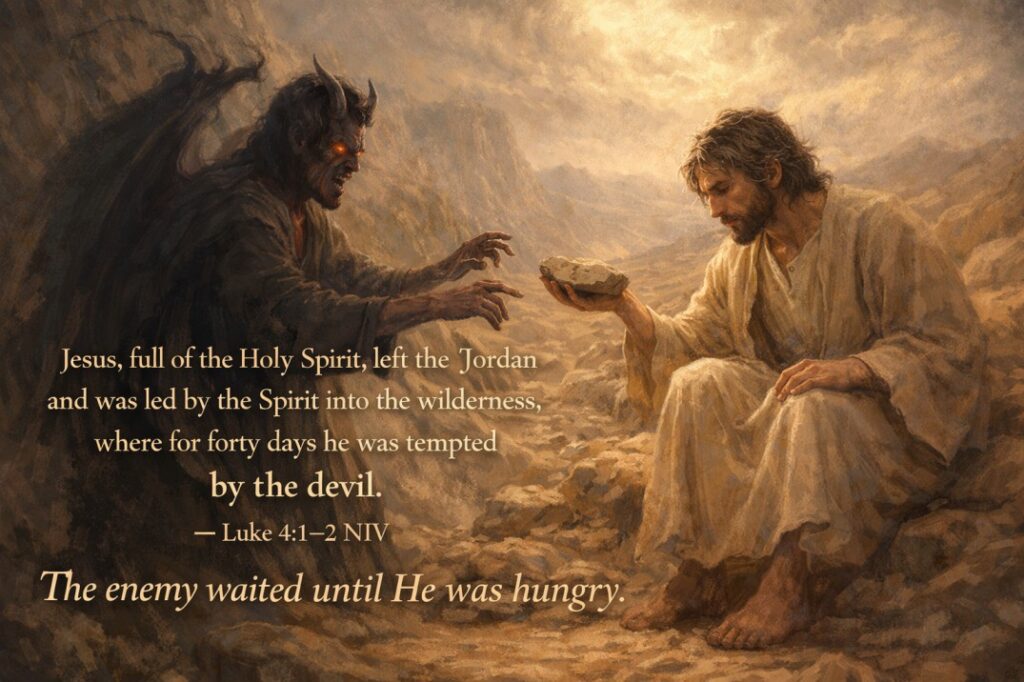
“Jesus, full of the Holy Spirit, left the Jordan and was led by the Spirit into the wilderness, where for forty days he was tempted by the devil.” — Luke 4:1–2 NIV
The enemy waited until He was hungry.
Forty days. No food. No shelter beyond what the desert provided. No company. And at the precise moment of maximum physical vulnerability, the attack began. That timing was not random. It was strategic. The adversary has always been opportunistic — targeting the exhausted, the isolated, the person whose resources have been depleted to the point where resistance feels impossible.
Christ’s wilderness temptation is the most theologically important spiritual warfare encounter in the New Testament. Not because it is the most dramatic — the final battle belongs to Calvary. But because it establishes the template. It shows us exactly how the enemy operates, what he targets, and how those attacks are defeated.
Every Christian who has ever faced a sustained season of spiritual attack will recognize the three movements of Matthew 4.
The Setup: Why Forty Days and Why Then?
The number forty carries enormous theological weight in Scripture. Israel wandered forty years. Moses spent forty days on Sinai twice. Elijah traveled forty days to Horeb. The flood lasted forty days. Nineveh was given forty days. The number consistently marks a period of testing, transition, and divine formation.
Jesus’ forty days was the recapitulation — the deliberate re-running of Israel’s entire wilderness history in concentrated form. Where Israel failed across forty years, Jesus would succeed in forty days. He was not just surviving a personal spiritual trial. He was accomplishing something representational on behalf of humanity.
Luke 4:1 adds a detail Matthew omits: Jesus entered the wilderness ‘full of the Holy Spirit.’ He came out of the Jordan’s water anointed, commissioned, and accompanied. The wilderness did not deplete that. It tested it. The Spirit did not leave Jesus in the wilderness. He led Him into it.
The First Temptation: Provision on Your Own Terms
‘If you are the Son of God, tell these stones to become bread’ (Matthew 4:3).
The attack is surgical. Jesus had not eaten in forty days. Turning stones to bread was within His power. The temptation was not to do something evil. It was to use legitimate power for personal provision outside of the Father’s direction and timing.
The ‘if you are the Son of God’ framing is the deeper blade. It was not genuine doubt — the enemy knew exactly who He was. It was an identity challenge dressed as a reasonable suggestion: your identity should express itself in self-provision. If you are really who you say you are, prove it by meeting your own needs.
Jesus answered with Deuteronomy 8:3 — the verse that records God’s explanation of the manna in the wilderness: ‘Man shall not live on bread alone, but on every word that comes from the mouth of God.’ He refused to be defined by His hunger or His power. He defined Himself by the Father’s word.
The spiritual warfare lesson: the first category of attack is almost always provision. The suggestion that you need to secure your own needs outside of God’s timing and method. The anxiety that says: if I wait for God, there will not be enough. The temptation to use legitimate capacity for self-protection in ways that circumvent trust.
The Second Temptation: Spectacle and Presumption
The enemy took Jesus to the pinnacle of the Temple in Jerusalem and quoted Psalm 91 back at Him: ‘If you are the Son of God, throw yourself down. For it is written: He will command his angels concerning you…’ (Matthew 4:6).
This is the most sophisticated of the three temptations. The enemy used Scripture. He quoted a real promise of divine protection and suggested that acting on it — dramatizing it publicly — would validate Jesus’ identity before the crowds who would be watching from below.
Jesus answered with Deuteronomy 6:16: ‘Do not put the Lord your God to the test.’ Claiming a promise of God’s protection as grounds for deliberately putting yourself in unnecessary danger is not faith. It is presumption. It treats God as a safety net for recklessness rather than as the sovereign director of a life lived in dependence.
The spectacle temptation is the enemy’s offer of a shortcut to the visible validation of your identity. You don’t need the long, hidden process of formation. Jump. Prove yourself publicly. Make God demonstrate His commitment to you on your terms and your timeline. The shortcut was available. Jesus refused it.
Why the Enemy Quotes Scripture
This is one of the most important observations in the entire temptation account. The adversary cited a genuine biblical text in support of a spiritually destructive action. That is not a primitive trick. It is a sophisticated strategy that has been deployed against Christians in every generation.
The defense is not to know less Scripture but to know it better — in context, in relationship to the whole counsel of God, with enough theological formation to recognize when a genuine promise is being twisted into a license for presumption. Jesus’ answer was not to debate the quotation. It was to provide the broader principle that governed it.
The Third Temptation: Power Without the Cross
The enemy showed Jesus all the kingdoms of the world and their glory and offered them without conditions: ‘All this I will give you, if you will bow down and worship me’ (Matthew 4:9).
The kingdoms were legitimately Jesus’ inheritance. Psalm 2:8 promises the nations as His possession. The temptation was not to receive something He had no right to. It was to receive the right thing by the wrong method — bypassing Gethsemane, bypassing Calvary, bypassing the resurrection, and taking a direct route to global dominion through a single act of worship offered to the wrong recipient.
‘Away from me, Satan!’ (Matthew 4:10). The only temptation Jesus refused with a command of dismissal rather than a scriptural citation. The offer of power without the cross was the most fundamental corruption of His mission — and He dispatched it with the shortest response of the three.
Deuteronomy 6:13: ‘Worship the Lord your God, and serve him only.’ The answer was not a counter-argument about the value of the cross. It was an absolute statement of exclusive allegiance. There was no universe in which the alternative was acceptable.
Angels Came and Attended Him
Matthew 4:11: ‘Then the devil left him, and angels came and attended him.’
The wilderness did not end in defeat. The enemy departed — not permanently, Luke 4:13 notes ‘until an opportune time’ — and the ministering spirits that had been present throughout arrived in visible form to provide what the body and spirit needed after forty days of fasting and sustained spiritual combat.
This sequence matters. The provision came after the test, not instead of it. The angels did not arrive in the first week with food to ease the forty days. They came when the test was finished. The sustenance was given at the point where it was both needed and appropriately timed.
That pattern recurs throughout Scripture and throughout Christian experience. The provision arrives when the test is complete — not to shorten it, but to sustain the person who has come through it.
The Three Categories of Attack: A Practical Framework
John identified the same three categories in 1 John 2:16: ‘the lust of the flesh’ (provision temptation — bread from stones), ‘the lust of the eyes’ (kingdoms and their glory — power without the cross), and ‘the pride of life’ (Temple pinnacle — spectacle and presumption).
Every spiritual attack you face fits one of these three categories. The enemy has not updated his methodology in two thousand years. He does not need to. The attacks work because the vulnerabilities are structural features of being human, not individual moral weaknesses.
The defense in each category is the same as Jesus demonstrated. Know which category of attack is present. Answer with the specific word of God that addresses that category. Refuse to define yourself by the attack’s implicit identity challenge. And trust that the provision, the validation, and the authority you legitimately need will come through God’s method and God’s timing — not through any shortcut the adversary is offering.
Reflection Questions
1. Which of the three temptations — provision on your own terms, spectacle and presumption, or power without the cross — is the dominant attack pattern in your current spiritual season?
2. How does the enemy’s use of Scripture in the second temptation change how you think about the importance of knowing biblical context rather than just individual verses?
3. What ‘shortcut to the kingdom’ has the enemy offered you — a way to reach a legitimate destination by a method that bypasses the cross?
Paul R. Schmidt writes on faith, spiritual warfare, and Christian survival fiction at myfaithtales.com.