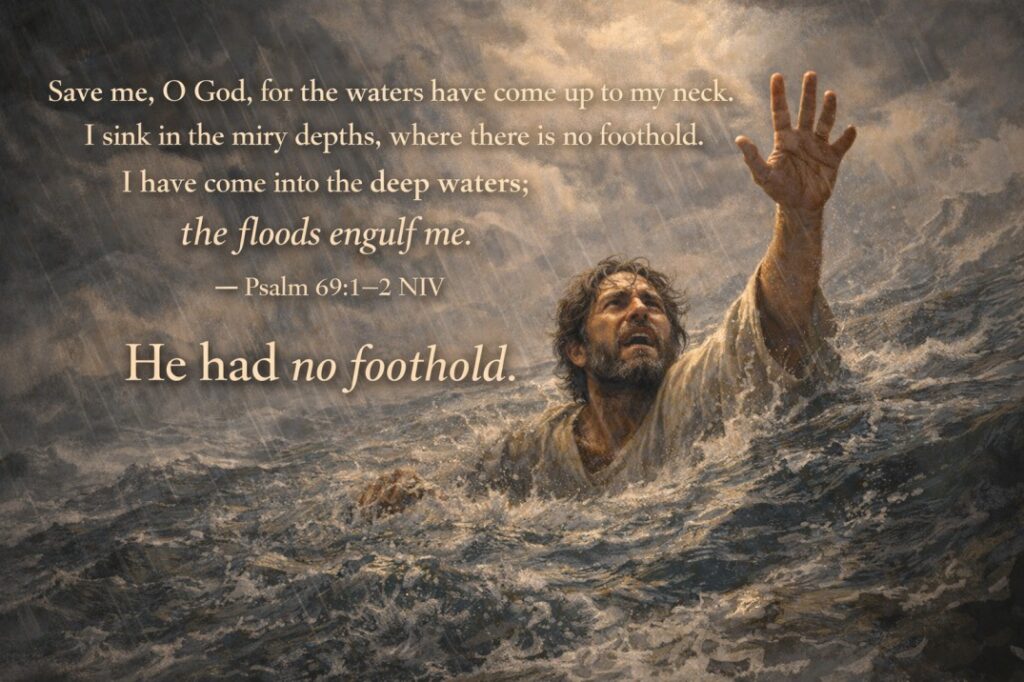
“Save me, O God, for the waters have come up to my neck. I sink in the miry depths, where there is no foothold. I have come into the deep waters; the floods engulf me.” — Psalm 69:1–2 NIV
He had no foothold.
That is the specific detail that makes Psalm 69 different from generic distress language. David was not standing in shallow water feeling anxious. He was in deep water with nothing to stand on — the miry depths, the place where a person’s feet find no purchase and the current does what it wants with you.
Psalm 69 is one of the most frequently quoted Psalms in the New Testament — cited in relation to Jesus more often than almost any other Old Testament text. It sits at the intersection of David’s deepest personal suffering and the messianic suffering it prefigures. Understanding it is essential both for reading the Passion narratives correctly and for navigating the seasons in your own life when the water is rising and there is no foothold.
The Setting: What David Was Facing
The superscription connects Psalm 69 to David, and the internal content suggests a period of sustained public opposition, personal shame, and the particular anguish of suffering that feels undeserved. Verses 4 and 9 both contain lines that the New Testament explicitly applies to Jesus: ‘Those who hate me without reason outnumber the hairs of my head’ (verse 4, cited in John 15:25) and ‘Zeal for your house consumes me’ (verse 9, cited in John 2:17 after the Temple cleansing).
David was also experiencing the social isolation that comes when a person’s public suffering becomes a source of shame rather than sympathy. Verse 12: ‘Those who sit at the gate mock me, and I am the song of the drunkards.’ The city gate was the public square. The drunkards were the lowest social tier. His suffering had become entertainment for those with nothing better to mock.
The Water Imagery: A Precise Vocabulary of Crisis
The opening verses of Psalm 69 build a detailed topography of drowning that deserves slow reading.
‘The waters have come up to my neck’ (verse 1). The Hebrew is literally ‘up to the soul’ — nephesh, the inner self. The water is not at his ankles or his waist. It has reached the part of him that makes him who he is.
‘I sink in the miry depths, where there is no foothold’ (verse 2). The miry depths — yeven metsulah — is swampy, sucking mud at the bottom of deep water. The place where the more you struggle, the deeper you go.
‘I have come into the deep waters; the floods engulf me’ (verse 2). Engulf — shibboleth — is the same word used for the flood narrative. This is not a difficult crossing. This is being overwhelmed.
‘I am worn out calling for help; my throat is parched. My eyes fail, looking for my God’ (verse 3). The exhaustion is total. Voice gone. Vision failing. He has been calling for help long enough that his throat has given out. The waiting has not been brief.
The Messianic Depth: What David Was Foreshadowing
The New Testament writers quoted Psalm 69 at key moments in the Passion narrative with a precision that suggests they understood David’s drowning as a deliberate theological preview of the cross.
John 19:28–29 records Jesus saying ‘I am thirsty’ just before His death — and the soldiers offering Him wine vinegar on a hyssop branch. John explicitly noted this fulfilled Scripture. The fulfillment text was Psalm 69:21: ‘They put gall in my food and gave me vinegar for my thirst.’ David’s thirst in the Psalm was the prefigurement of the thirst at Calvary.
Romans 15:3 cites Psalm 69:9 — ‘the insults of those who insult you have fallen on me’ — as a description of Christ bearing the reproach that belonged to others. The drowning David described was, at its deepest level, a shadow of what Jesus experienced when He bore the weight of human sin and went under it completely.
The resurrection is the answer to Psalm 69. The man who sank to the miry depths with no foothold did not stay there. God heard the cry of verse 33 — ‘the Lord hears the needy and does not despise his captive people’ — and answered it in the most definitive way possible.
The Turn: Verse 13 and What Follows
Psalm 69 does not stay in the drowning water. Verse 13 is the pivot: ‘But I pray to you, Lord, in the time of your favor; in your great love, O God, answer me with your sure salvation.’
The ‘but’ is doing the same work it does in every lament psalm — acknowledging the full reality of the crisis while refusing to let it be the last word. David had described his situation with complete honesty. Now he turned it over to a God whose favor and love existed independently of the crisis.
Verses 30–33 complete the turn with one of the more honest statements about worship in the Psalter: ‘I will praise God’s name in song and glorify him with thanksgiving. This will please the Lord more than an ox, more than a bull with its horns and hooves. The poor will see and be glad — you who seek God, let your hearts live!’
The worship that came out of the drowning was not performance. It was the testimony of a man who had been in the miry depths with no foothold and had been heard. That testimony — the specific, detailed, honest account of what God had done in the worst water — was what the poor and the seeking could hold onto. David’s drowning, documented and published, became the faith anchor for everyone who would ever find themselves in the same water.
For the Person Whose Throat Is Parched
If you are in verse 3 right now — voice worn out, eyes failing from looking for God — Psalm 69 was written for exactly this moment. Not around it. Not past it. For it.
David did not pretend the water was not real. He described it with precision. He catalogued the exhaustion, the shame, the social isolation, the specific physical details of a person going under. And he did not stop addressing God. Even when the throat was parched, the address continued.
The foothold you do not have in the miry depths is not God’s absence. It is the condition in which God most directly demonstrates that He is the only thing that does not shift. The miry depths have no foothold for human effort. They do have a floor. And the floor is what you land on when everything else has given way.
Reflection Questions
1. What is the specific water you are in right now — and how close is it to your neck?
2. How does the New Testament application of Psalm 69 to Jesus change how you read your own season of drowning?
3. David’s testimony of being heard became a faith anchor for others. Who in your life needs to hear your specific account of what God did in your worst water?
Paul R. Schmidt writes on faith, survival, and Christian survival fiction at myfaithtales.com.