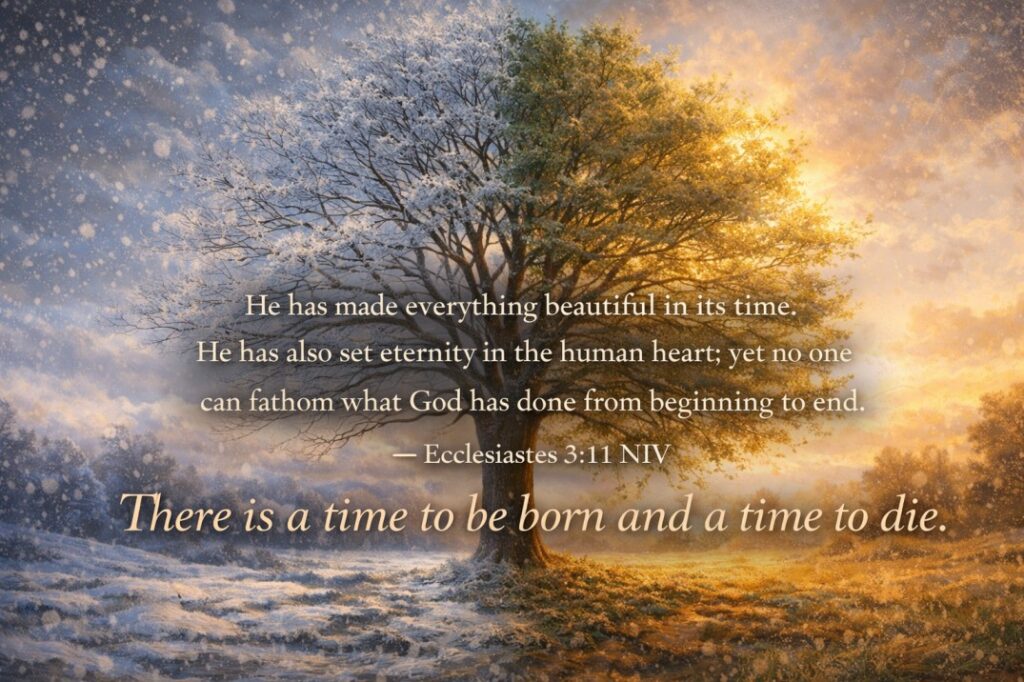
“He has made everything beautiful in its time. He has also set eternity in the human heart; yet no one can fathom what God has done from beginning to end.” — Ecclesiastes 3:11 NIV
There is a time to be born and a time to die.
There is a time to plant and a time to uproot. A time to weep and a time to laugh. A time to mourn and a time to dance. Fourteen pairs of opposites in fourteen verses — and every single one of them is listed without moral qualification. The weeping is not less than the laughing. The mourning is not less than the dancing. They are both included. Both timed. Both governed.
Ecclesiastes 3 is the most sophisticated treatment of time in the wisdom literature. And it is almost always domesticated into a greeting card when it deserves to be taken as a load-bearing theological argument.
Qoheleth: The Voice Behind the Text
The author identifies himself as Qoheleth — a Hebrew word that most translations render as ‘the Teacher’ or ‘the Preacher.’ Traditionally attributed to Solomon, the book is a sustained meditation on the limits of human wisdom and the sovereignty of God over a world that does not always make sense from inside it.
The framing word of Ecclesiastes — hebel — is translated ‘vanity’ or ‘meaningless’ in most English versions. The literal meaning is breath or vapor. Qoheleth is not saying life is worthless. He is saying it is fleeting, insubstantial, impossible to grip. The human attempt to control outcomes and force meaning is, from this perspective, like trying to hold vapor in your fist.
Chapter 3 is the theological answer to that condition. If human effort cannot secure outcomes, who governs them? The answer is God — specifically, a God who has appointed a time for everything.
The Fourteen Pairs: A Closer Look
The poem in verses 1–8 is not a celebration of natural cycles. It is a declaration of divine sovereignty over every possible human experience — including the painful ones.
‘A time to kill and a time to heal.’ This is not endorsing murder. It is including even the most extreme human experiences within the scope of God’s governance. War. Death. Loss. They are not outside His timing. They are inside it.
‘A time to tear and a time to mend.’ The tearing is not an error to be corrected. It is a season that precedes the mending. Both are real. Both are timed.
‘A time to be silent and a time to speak.’ This pair is significant for anyone in a prolonged waiting season. The silence is not a malfunction. It may be a season. The question is not whether God has gone quiet. The question is whether the silence is itself part of what He is doing.
Verse 11: The Theological Core
Verse 11 is where the poem turns into doctrine: ‘He has made everything beautiful in its time. He has also set eternity in the human heart; yet no one can fathom what God has done from beginning to end.’
Three claims in one verse.
First: ‘He has made everything beautiful in its time.’ The Hebrew word for beautiful here — yapheh — means fitting, appropriate, right for the moment. Not that every event is pleasant. That in its proper time, within God’s design, it is exactly what it should be. The pain is not a mistake at the right time. The waiting is not a failure at the right time.
Second: ‘He has set eternity in the human heart.’ This is a profound anthropological claim. Humans are not content with the temporal because they were made for more than the temporal. The longing you feel when the waiting goes on too long — the sense that this should not be the whole story — is not evidence of weak faith. It is the imprint of eternity on a creature designed for it. You ache for resolution because you were built for a resolution that only eternity provides.
Third: ‘Yet no one can fathom what God has done from beginning to end.’ The human position is inside the narrative. You see chapters. God sees the complete arc. The timing that confuses you from inside the crisis is perfectly calibrated from outside it.
The Practical Theology of Waiting
Ecclesiastes 3 does not tell you how long the hard season will last. It does not promise the timing you want. What it gives you is this: the season you are in is not random. It is appointed. And the God who appointed it has made everything — including this — fitting in its time.
That is a harder peace than the peace of resolution. Resolution says ‘it’s over.’ Ecclesiastes 3 says ‘it’s governed.’ You can have that peace before the circumstances change. You can have it in the hospital room, in the waiting room, in the long middle of a chapter you cannot yet see the end of.
The peace does not come from understanding the timing. It comes from trusting the One who governs it.
Reflection Questions
1. Which of the fourteen pairs in Ecclesiastes 3:1–8 describes the season you are currently in?
2. How does the concept of eternity being set in your heart explain the ache you feel when circumstances do not resolve on a human timeline?
3. What would it mean in your specific situation to trust God’s timing before you can see how it will work out?
Paul R. Schmidt writes on faith, sovereignty, and Christian survival fiction at myfaithtales.com.